-1.png?width=300&height=159&name=CAJF%20618X159%20(1)-1.png "CAJF 618X159 (1)-1")
The Investment & Sustainability Advisory Committee
Charting the path forward with the LA Collaborative's new governance structure
What is the Investment Sustainability Advisory Committee (ISAC)?
ISAC
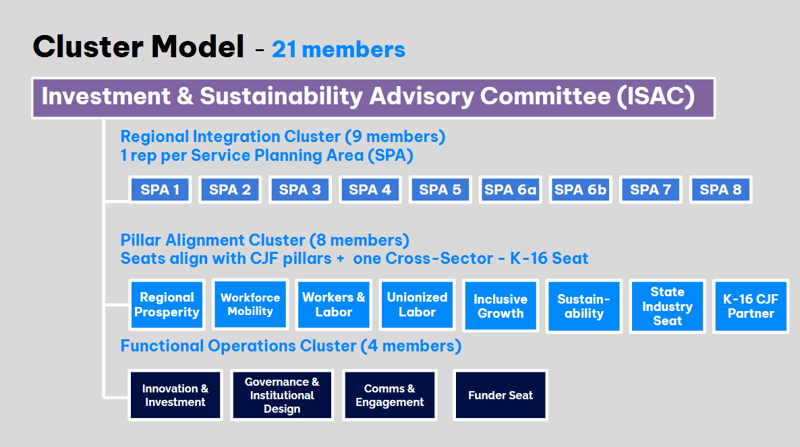
Previously a 15-member committee, the 21-member Investment & Sustainability Advisory Committee (ISAC) is a cross-sector regional body that serves as the region’s transition body and guides long-term strategy beyond the California Jobs First grant closeout in September 2026.
The committee seats fall under three cluster categories to ensure balance, expertise, and operational strength: (1) Regional (2) Pillar (3) Functional
ISAC is responsible for:
- Shaping investment priorities
- Strengthening coordination
- Sustaining the momentum of the LA Collaborative's countywide collaboration
What changed about ISAC and How Can I Apply for a Seat?
Our new structure has been redesigned with increased representation to help guide long-term direction of the CJF LA Collaborative:
- Regional Seats
- No longer representative of Supervisorial Districts and are now representative of each Service Planning Area (SPA) of LA County
- Pillar Seats
- Added a seat for Unionized Labor and institutionalized the Industry Seat to a State Industry Seat
- Functional Seats
- Added a Funder Seat, which will be appointed rather than elected
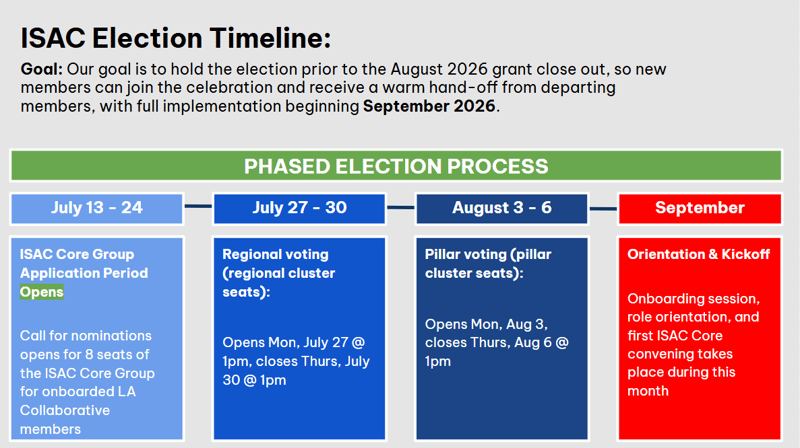
Apply for an ISAC Seat
-
Applications for open ISAC seats close July 24, 2026, at 5PM
Who are the current Investment Sustainability Advisory Committee (ISAC) members?
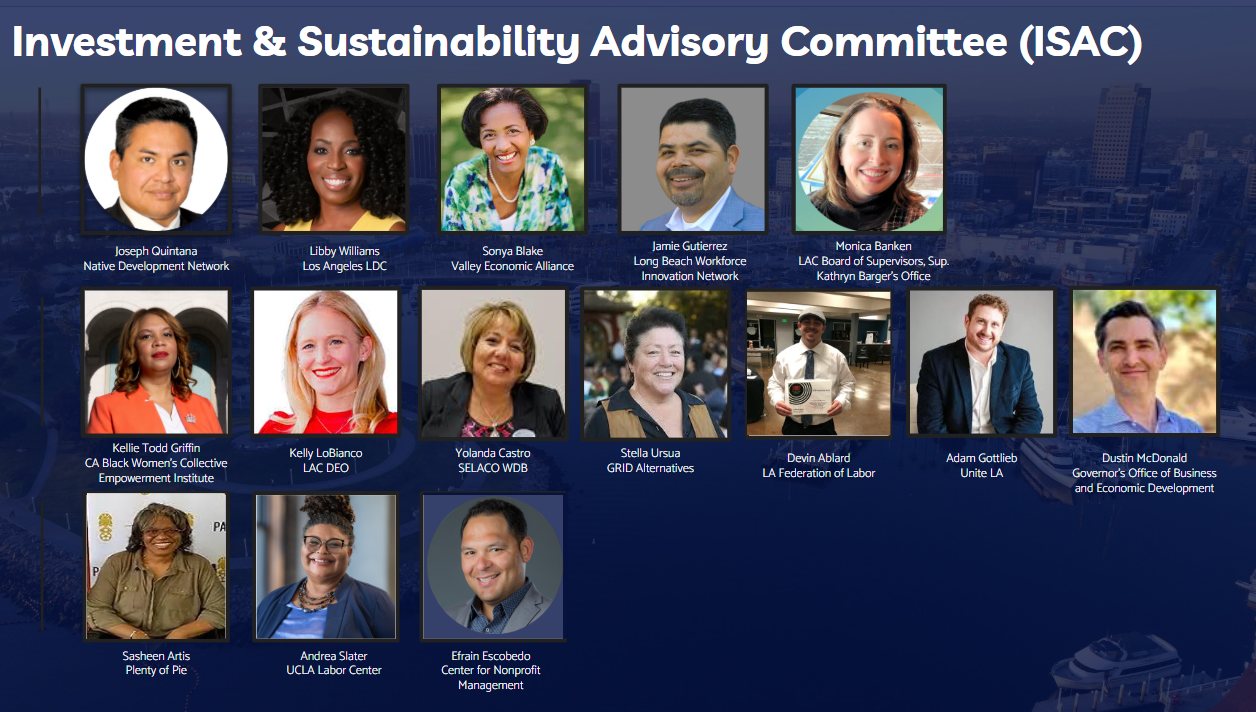
Current ISAC Core Group: 15 members
Regional Cluster (5 Seats)
Countywide reach across Supervisorial Districts
- SD 1 Seat: Joseph Quintana - Native Development Network
- SD 2 Seat: Libby Williams - Los Angeles LDC
- SD 3 Seat: Sonya Blake - Valley Economic Alliance
- SD 4 Seat: Jaime Gutierrez - Long Beach Workforce Innovation Network
- SD 5 Seat: Monica Banken - LA County Board of Supervisors, Supervisor Kathryn Barger's Office
Functional Operations Cluster (3 Seats)
Focused on operational leadership, convening capacity, and regional coordination
- Innovation & Investment Seat:
- Efrain Escobedo - Center for Nonprofit Management
- Efrain Escobedo - Center for Nonprofit Management
- Governance & Institutional Design Seat:
- Andrea Slater - UCLA Labor Center
- Andrea Slater - UCLA Labor Center
- Communications & Engagement Seat:
- Sasheen Artis - Plenty of Pie
Pillar Alignment Cluster (7 Seats)
Aligned with CJF impact pillars & cross-sector expertise
- Workforce Mobility Seat:
- Yolanda L. Castro - Southeast Los Angeles County Workforce Development Board (SELACO WDB)
- Yolanda L. Castro - Southeast Los Angeles County Workforce Development Board (SELACO WDB)
- Regional Prosperity Seat:
- Kelly Lobianco - LA County Department of Economic Opportunity (LA DEO)
- Kelly Lobianco - LA County Department of Economic Opportunity (LA DEO)
- Workers & Labor Seat:
- Devin T. Ablard - Los Angeles County Federation of Labor
- Devin T. Ablard - Los Angeles County Federation of Labor
- Inclusive Growth Seat:
- Kellie Todd Griffin - CA Black Women's Collective Empowerment Institute
- Kellie Todd Griffin - CA Black Women's Collective Empowerment Institute
- Sustainability Seat:
- Stella Ursua - GRID Alternatives Southern California
- Stella Ursua - GRID Alternatives Southern California
- Industry Seat:
- Dustin McDonald - Governor's Office of Business & Economic Development (GO-Biz)
- Dustin McDonald - Governor's Office of Business & Economic Development (GO-Biz)
- K-16 Collaborative Seat:
- Carrie Lemmon - UNITE-LA
ISAC Deliverables
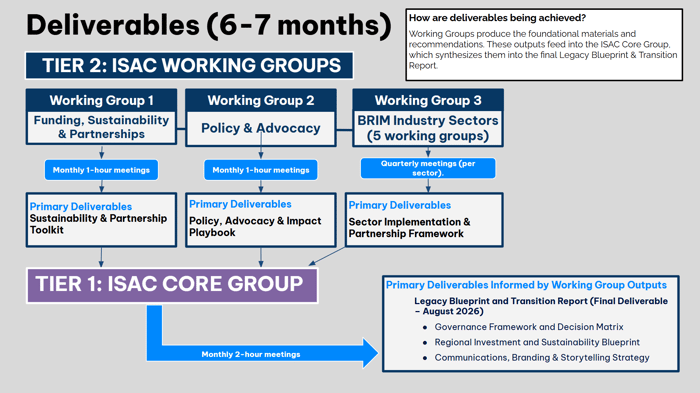
Over the next 6-7 months, ISAC's work is organized into two tiers to produce the Legacy Blueprint & Transition Report
Tier 2 — Working Groups
Provide foundational materials:
-
Funding, Sustainability & Partnerships: Sustainability toolkit; 1 hr/month
-
Policy & Advocacy: Policy & advocacy playbook; 1 hr/month
-
BRIM Industry Sectors: Sector frameworks; quarterly
Outputs feed directly into Tier 1.
Tier 1 — ISAC Core Group
-
Integrates Tier 2 materials; 2 hrs/month
-
Produces Legacy Blueprint & Transition Report (Aug 2026) including:
-
Governance Framework & Decision Matrix
-
Regional Investment & Sustainability Blueprint
-
Communications & Storytelling Strategy
-